 TributeLegacy
bronze plaque · Scotland
Mary Somerville
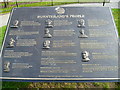
Burntisland's People Wilfrid Ayre (1890-1971) Shipbuilder and public servant. Founded Burntisland Shipyard, which opened in 1918. Knighted for his services in the Second World War. William Bald (c1788-1857) Born in Burntisland. Pioneering cartographer, surveyor and civil engineer in Scotland and Ireland. Designed and built the Antrim coast road, one of the world's great scenic routes. Thomas Chalmers (1780-1847) Citizen of Burntisland. Radical preacher, social reformer, and the leading Scottish churchman of his generation. Founder of the Free Church of Scotland (1843). John Clephane 16th century ship-owner and politician. Formed Burntisland's first Town Council in 1586. First Provost of the town (1586-88). Raised the funds to build the new Parish Church in East Leven Street. David Danskin (1863-1948) Born in Burntisland. Founder and first Captain of Arsenal Football Club. William Dick (1703-1866) Founder of the Royal (Dick) School of Veterinary Studies, Edinburgh. Planned Craigkennochie Terrace, Burntisland, where he lived. Henry Brougham Farnie (1836-1889) Born in Burntisland. Prolific librettist and writer, whose operettas were record-breaking hits on the London stage. Author of the world's first golf instruction manual. George Hay Forbes (1821-1875) Episcopalian priest in Burntisland. Eminent scholar. Publisher and printer of religious works. Designed and built the Parsonage in East Leven Street. Emma Maitland Stirling (1838-1907) Radical and nationally significant campaigner against child abuse. Lived in Burntisland, where she maintained two children's homes. Alexander Orrock Appointed Mintmaster for Scotland in 1538. Introduced the bawbee coin, named after his Burntisland estate of Silliebawbie (Silverbarton). Robert Pitcairn (1752-c1770) Born in Burntisland. Discovered Pitcairn Island in 1767 while a Midshipman on HMS Swallow. Lost at sea, aged 17. James Robertson (1717-1788) Born at Newbigging, Burntisland. Rose from Private to General in the British Army. As the last colonial Governor of New York (1779-83), he strove to find a peaceful solution to American grievances. Mary Somerville (1780-1872) Lived in the family home in Burntisland from 1780 to 1804. Pioneering and eminent mathematician and astronomer. Strong supporter of the emancipation and education of women. Somerville College, Oxford, perpetuates her name. James Thomson (c1681-1766) Minister of Burntisland Parish Church from 1719 to 1738. One of the eight ministers who joined the first major secession from the Church of Scotland in the 1730s/ Established Burntisland's Associate Congregation, of which today's Erskine Church is the direct descendant. Andrew Young (1854-1925) Born and lived in Burntisland. Photographer and artist of national significance. Restored the guild panels of Burntisland Parish Church (1907-10). William Young (c1745-1831) Distiller and farmer. Established the Grange Distillery in 1786. His descendants built and donated Burtisland's first Free Church and School building; and erected the Music Hall which they gifted to the town in 1869.
Inscription drawn from imported open data, awaiting original TributeLegacy editorial.
Source: Open Plaques. Geographic data via OpenStreetMap.