 TributeLegacy
plaque · England
King George III of Great Britain of the United Kingdom
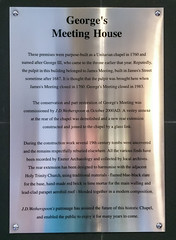
George's Meeting House These premises were purpose-built as a Unitarian chapel in 1760 and named after George III, who came to the throne earlier that year. Reputedly, the pulpit in this building belonged to James Meeting, built in James's street sometime after 1687. It is thought that the pulpit was brought here when James's Meeting closed in 1760. George's Meeting closed in 1983. The conservation and part restoration of George's Meeting was commissioned by J.D. Wetherspoon in October 2000AD. A vestry annexe at the rear of the chapel was demolished and a new rear extension constructed and joined to the chapel by a glass link. During the construction work several 19th century tombs were uncovered and the remains respectfully reburied elsewhere. All the various finds have been recorded by Exeter Archaeology and collected by local archive. The rear extension has been designed to harmonise with the adjacent Holy Trinity Church, using traditional materials - flamed blue-black slate for the base, hand-made red brick in lime mortar for the main walling and lead-clad parapet aerofoil roof - blended together in a modern composition. J.D. Wetherspoon's patronage has assured the future of this historic Chapel, and enable the public to enjoy it for many years to come.
Inscription drawn from imported open data, awaiting original TributeLegacy editorial.
Source: Open Plaques. Geographic data via OpenStreetMap.