
blue plaque · Northern Ireland
John McKay
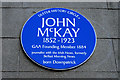
This blue plaque commemorates John McKay, a significant figure in both Irish journalism and sports. Born in Downpatrick in 1852, McKay was instrumental in the establishment of the Gaelic Athletic Association (GAA) in 1884, an organisation dedicated to preserving and promoting Ireland's indigenous games and culture. Beyond his sporting contributions, McKay also made his mark in the newspaper industry, serving as a journalist for the Irish News and previously for the Belfast Morning News. The plaque acknowledges his dual legacy as a pioneer in Irish sport and a respected voice in the press.
The memorial to John McKay stands as a testament to individuals who shaped Irish cultural and political life in the late 19th and early 20th centuries. This period saw the rise of various nationalist and cultural movements across Ireland, seeking to assert a distinct Irish identity. The founding of the GAA, in particular, was a pivotal moment in this broader cultural revival, aiming to counter the dominance of British sports and promote Gaelic games. McKay's involvement places him firmly within this tradition of cultural advocacy, reflecting a time when journalism also played a crucial role in shaping public opinion and contributing to national discourse.
The blue plaque honouring John McKay is situated on the Irish News Building, located at 113-117 Donegall Street in Northern Ireland. This prominent city centre location makes it accessible for visitors wishing to learn more about McKay's contributions. The building itself is an active premises, and visitors can easily view the plaque from the pavement. Donegall Street is a key thoroughfare, often bustling with people, allowing for respectful observation of the memorial in its urban setting.
Inscription
“JOHN McKAY 1852-1923 GAA Founding Member 1884 journalist with the Irish News, formerly Belfast Morning News born Downpatrick”
Background
John Alexander McKay (born 1945) was a Northern Irish unionist politician.
Source: Open Plaques. Geographic data via OpenStreetMap.