
blue plaque · Northern Ireland
Alexander Irvine
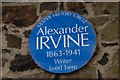
A blue plaque at Pogue's Entry commemorates Alexander Irvine, a writer who lived at this address. The plaque serves as a public reminder of his connection to the location, marking a place significant in his personal history. These markers are commonly used to celebrate individuals who have made notable contributions, providing a tangible link between a person of historical interest and a specific place. The presence of the plaque indicates local recognition of Irvine's literary work and his residence within the community during his lifetime.
The surname Irvine originates from Scotland, derived from the River Irvine, and is frequently found in Northern Ireland, a consequence of the Ulster Scots migration. This historical movement saw significant numbers of Scottish people settle in Ulster, bringing their culture and names with them. Over time, 'Irvine' also transitioned from being solely a surname to being used as a given name. The presence of such a name in Northern Ireland, where blue plaques often honour figures of regional and national importance, reflects the deep historical and cultural ties between Scotland and this part of Ireland.
The memorial for Alexander Irvine is a blue plaque situated at Pogue's Entry in Northern Ireland. Visitors will find the plaque affixed to a building, clearly visible from the public thoroughfare. Blue plaques are designed to be easily accessible to members of the public, allowing for a respectful viewing from the street level. As it is a public commemoration, no special arrangements are typically needed to observe the plaque, which stands as a quiet tribute in its urban setting.
Inscription
“Alexander Irvine 1863-1941 writer lived here”
Background
The surname Irvine, which also appears as a given name, has origins in Scotland, specifically from the area surrounding the River Irvine. This name is also frequently found in Northern Ireland, a prevalence likely stemming from the migration of Ulster Scots people to the region.
Original summary by TributeLegacy, informed by public sources.
Source: Open Plaques. Geographic data via OpenStreetMap.