
black plaque · London
King George III of Great Britain of the United Kingdom
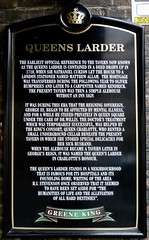
Queens Larder The earliest official reference to the tavern known as the Queens Larder is contained in a deed drawn up in 1710, when Sir Nathaniel Curzon let the house to a London stationer named Matthew Allan. The mortgage was transferred during the following year to Oliver Humphries and later to a carpenter named Kendrick. The present tavern was a simple alehouse without an inn sign. It was during this era that the reigning sovereign, George III, began to be effected by metal illness, and for a while he stayed privately in Queen Square under the care of Dr. Willis. The doctor’s treatment which was temporarily successful, was helped by the King’s Consort, Queen Charlotte, who rented a small underground cellar beneath the present tavern in which She stored special delicacies for her sick husband. When the alehouse became a tavern later in George’s reign , it was named the Queen’s Larder in Charlotte’s honour. The Queen’s Larder stands in a neighbourhood that is famous for its hospitals and its Foundling Home. Writing of the area R.I. Stevenson once observed that it seemed to have been set aside for “the humanities of life and the alleviation of all hard destinies”
Source: Open Plaques. Geographic data via OpenStreetMap.