
red plaque · London
James Thomson
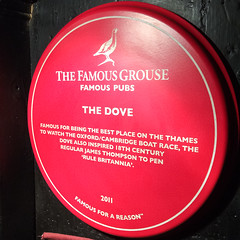
The plaque at The Dove commemorates James Thomson, a figure associated with the famous "Rule Britannia." This recognition highlights his connection to the establishment, suggesting a place where his creative inspiration flourished. While the James Thomson known for "Rule Britannia" was an 18th-century Scottish poet and playwright, the plaque specifically links him to this London public house. The enduring presence of "Rule Britannia" in British culture underscores the significance of the work attributed to Thomson and, by extension, the places that inspired him. This memorial serves as a notable reminder of the cultural heritage embedded within historic London venues.
The memorial dates from an era where public houses often served as important cultural and social hubs, fostering literary and artistic creation. In the 18th century, coffee houses and taverns were common meeting places for intellectuals, writers, and artists, providing environments conducive to discussion and inspiration. The act of commemorating individuals at such locations reflects a long-standing tradition of marking the significant, albeit sometimes less formal, sites of cultural achievement. This plaque participates in a broader civic impulse to acknowledge the historical figures and moments that have shaped local and national identity.
This commemorative plaque can be found at The Dove, a historic public house situated on Upper Mall in Hammersmith, London. Visitors to The Dove will find it prominent at an establishment renowned for its riverside location on the Thames. The pub offers views that are particularly famous for watching the annual Oxford/Cambridge boat race. Accessing The Dove is straightforward, and visitors are encouraged to be mindful of other patrons while observing the plaque. The pub's location in a picturesque part of London makes it an inviting destination for those interested in local history and literary connections.
James Michael Douglas Thomson (born 1966) is a chartered accountant and Common Councilman for Walbrook Ward of the City of London Corporation since 2013. He is non-executive Chairman (since 2022) and former Chief Executive of MJ Gleeson plc, the listed housebuilder of low cost quality homes. In June 2019, he was appointed interim CEO at MJ Gleeson, and became the permanent CEO in December 2019. In April 2022, Thomson announced his intention to stand down on 31 December 2022, with Vistry Group's chief operating officer Graham Prothero nominated as his successor. Thomson become a non-executive Chairman at MJ Gleeson on 1 January 2023. Thomson was Chief Executive Officer for Keepmoat and was a non-executive board member of the Housing and Finance Institute. Thomson was appointed chief financial officer of Keepmoat in 2012. Then in January 2015, following the acquisition of Keepmoat by TDR Capital and Sun Capital, he was promoted to the post of deputy CEO, later becoming CEO. Thomson is a board member of the Serious Fraud Office and chairman of its Audit and Risk Committee. A graduate of Oriel College, Oxford, and lately Chairman of the City of London Police Authority Board, Thomson was appointed CBE in the 2025 New Year Honours for Policing and Inclusion. Following the Autumn Statement of Conservative Chancellor Philip Hammond in November 2016, Thomson welcomed the £2.3 billion housing infrastructure fund as he saw it as allowing local authorities to create joint ventures to deliver housing.
Source: Open Plaques. Geographic data via OpenStreetMap.