
blue plaque · England
William Butler
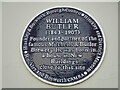
This blue plaque commemorates William Butler, a notable figure from the 19th and early 20th centuries, recognised as a founder and partner of the renowned Mitchells & Butler Brewery. His entrepreneurial spirit helped establish an enterprise that would become a significant part of the region's industrial landscape. The plaque serves as a reminder of his origins and contribution to local commerce and industry, marking the location near where he was born in New Buildings.
The memorial dates from an era of significant industrial growth and entrepreneurial activity in England, a period during which many family businesses grew into national institutions. It stands within the tradition of blue plaques that honour individuals for their notable contributions across various fields, often connecting their legacy directly to their places of birth or residence. This practice of marking historical sites became more widespread from the late 19th century onwards, aiming to preserve local heritage and acknowledge the lives of those who shaped their communities and industries.
The memorial is a blue plaque situated at The Greyhound in New Buildings, England. Visitors will find it affixed to the exterior of the building, indicating a significant historical connection to this specific location. This type of plaque is typically mounted on a wall at a publicly accessible height, allowing for close inspection and easy reading of its inscription. As it is on a public building, it can be viewed respectfully during typical visiting hours for the area.
Inscription
“William Butler (1843-1907) Founder and partner of the famous Mitchells & Butler Brewery. He was born in a house in New Buildings close to this site”
Background
William the Conqueror (c. 1028 – 9 September 1087), sometimes called William the Bastard, was the first Norman king of England (as William I), reigning from 1066 until his death. A descendant of Rollo, he was Duke of Normandy (as William II) from 1035 onward. By 1060, following a long struggle, his hold on Normandy was secure. In 1066, following the death of Edward the Confessor, William invaded England, leading a Franco-Norman army to victory over the Anglo-Saxon forces of Harold Godwinson at the Battle of Hastings. He suppressed subsequent English revolts in what has become known as the Norman Conquest. The rest of his life was marked by struggles to consolidate his hold over England and his continental lands, and by difficulties with his eldest son, Robert Curthose. William was the son of the unmarried Duke Robert I of Normandy and his mistress Herleva. His illegitimate status and youth caused some difficulties for him after he succeeded his father, as did the anarchy which plagued the first years of his rule. During his childhood and adolescence, members of the Norman aristocracy battled each other, both for control of the child duke, and for their own ends. In 1047, William quashed a rebellion and began to establish his authority over the duchy, a process that was not complete until about 1060.
Source: Open Plaques. Geographic data via OpenStreetMap.