 TributeLegacy
bronze plaque · England
St Martin's Gate
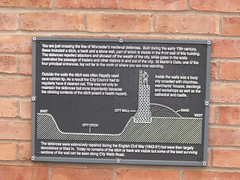
You are just crossing the line of Worcester's medieval defence's. Built during the early 13th century, these included a ditch, a bank and a stone wall, part of which is visible in the front of this building. The defences repelled attackers and showed off the wealth of the city, while gates in the walls controlled the passage of traders and other visitors in and out of the city. St Martin's Gate, one of the four principal entrances, lay not far to the north of where you are now standing. Outside the walls the ditch was often illegally used as a rubbish tip. As a result the City Council had to regularly have it cleaned out. This was not only to maintain the defences but more importantly because the stinking contents of the ditch posed a health hazard. Inside the walls was a busy city crowded with churches, merchants' houses, dwellings and workshops as well as the cathedral and castle. The defences were extensively repaired during the English Civil War (1642-51) but were then largely demolished or filled in. Today no remains of the ditch or bank are visible but some of the best surviving sections of the wall can be seen along City Walls Road.
Inscription drawn from imported open data, awaiting original TributeLegacy editorial.
Source: Open Plaques. Geographic data via OpenStreetMap.