
WAR MEMORIALwar memorial · Birmingham
PYPE HAYES MEMORIAL STONE AND GARDEN
Click to remember them. Lest we forget.
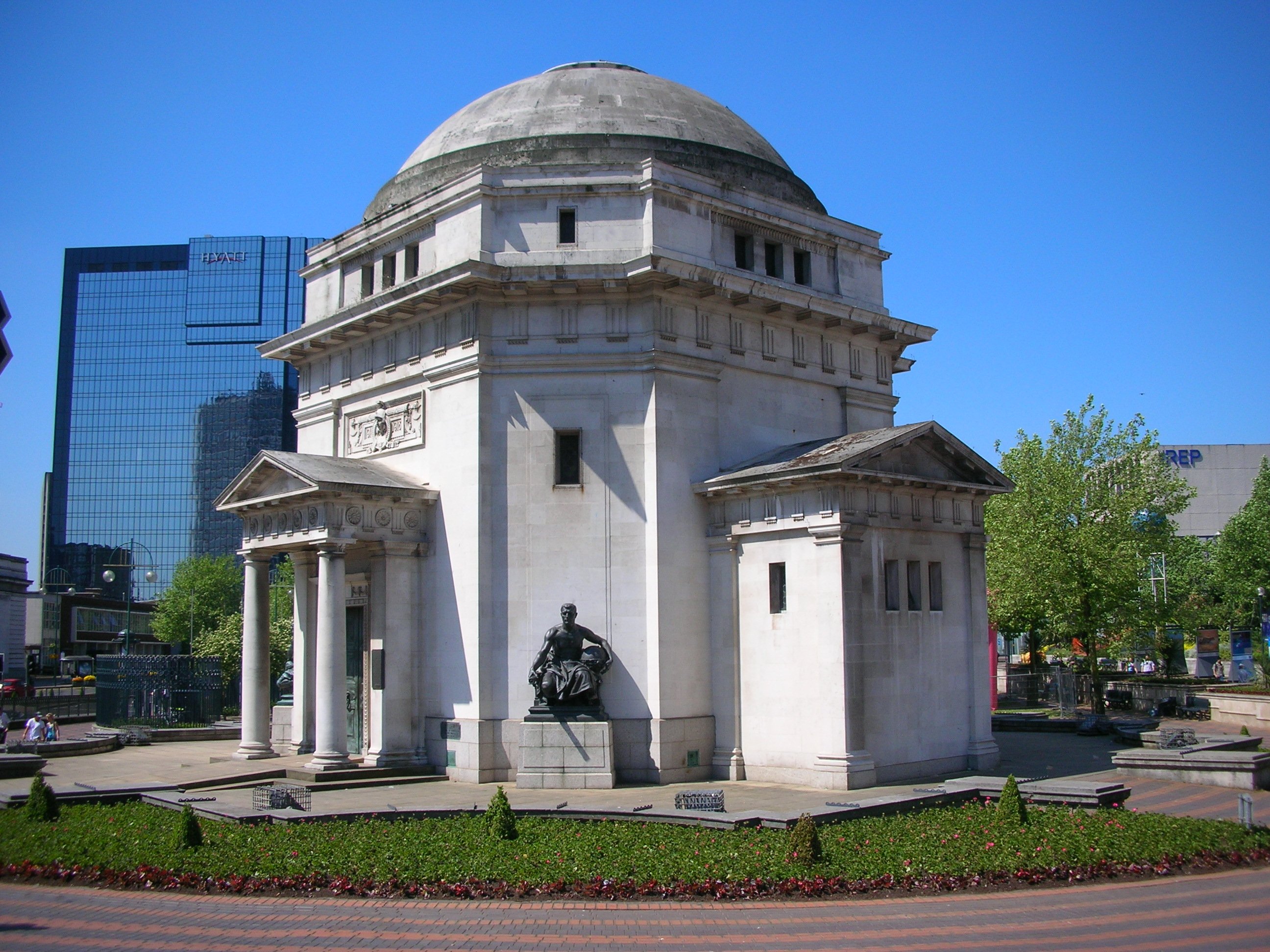
The Hall of Memory is a war memorial in Centenary Square, Birmingham, England, designed by S. N. Cooke and W. N. Twist. Erected 1922–25 by John Barnsley and Son, it commemorates the 12,320 Birmingham citizens who died in World War I. Built directly over a filled-in canal basin of Gibson's Arm, it was the first structure in an area (now occupied by Centenary Square and the International Convention Centre and Symphony Hall) purchased by the council for the creation of a grand civic scheme to include new council offices, the mayor's residence, a public library, and a concert hall. The scheme was abandoned after the commencement of World War II with only half of one wing of the planned Baskerville House having been built.
Made from Portland stone, from the Isle of Portland in Dorset, the foundation stone was laid by the Prince of Wales on 12 June 1923 and it was opened by Prince Arthur of Connaught on 4 July 1925 to a crowd of 30,000. Construction had cost £60,000 and was funded through public donations. The four statues around the exterior are by local artist Albert Toft. They represent the Army, the Navy, the Air Force, and Women's Services.
The interior features three carved bas-relief plaques (155 cm x 223 cm) by William Bloye representing three tableaux: Call (departure to war), Front Line (fighting), Return (arrival home of the wounded). These bear inscriptions:
OF 150,000 WHO ANSWERED THE CALL TO ARMS 12,320 FELL: 35,000 CAME HOME DISABLED AT THE GOING DOWN OF THE SUN AND IN THE MORNING WE WILL REMEMBER THEM SEE TO IT THAT THEY SHALL NOT HAVE SUFFERED AND DIED IN VAIN +*+
There is also a roll of honour illustrated by Sidney Meteyard. The hall was upgraded on 27 October 2014 to a Grade I listed building from its previous Grade II.
During the Birmingham Blitz, on the night of 11 December 1940, all but the fine tower and classical west portico of St Thomas' Church, Bath Row, was destroyed by German bombs.
Photographs


Images via Wikimedia Commons - click to view licensing & full resolution.
Source: OpenStreetMap. Geographic data via OpenStreetMap.